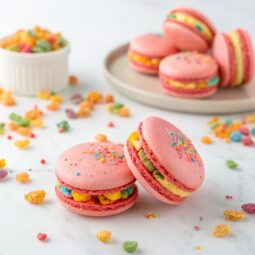
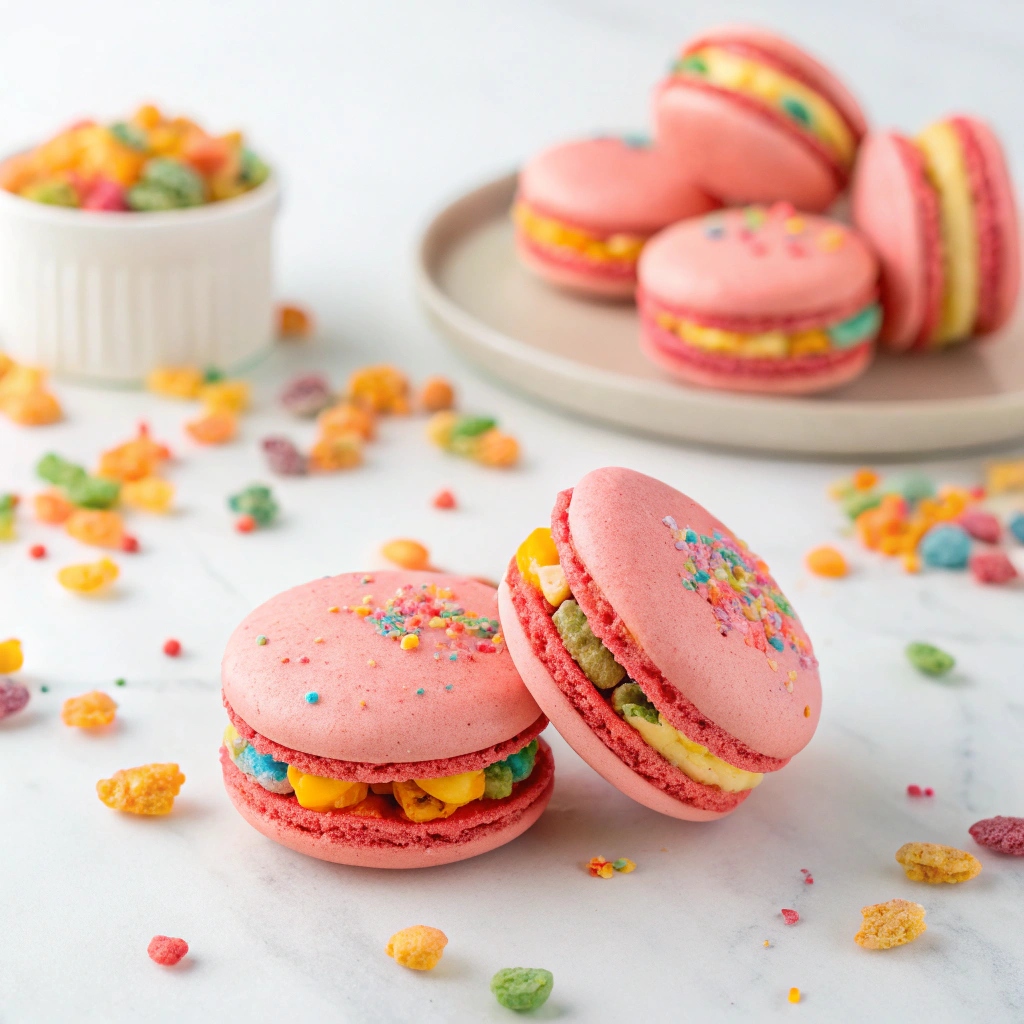
Few desserts turn heads the way a plate of Fruity Pebble macarons does. Bright speckled shells, freckled with crushed cereal, hide a creamy pastel filling that tastes like Saturday morning cartoons in a single bite. This Fruity Pebble macarons recipe takes the fussy French classic and gives it a playful, kid-friendly twist without sacrificing the crackly shell and chewy center that make macarons famous. The secret is in the macaronage, the slow, deliberate folding that turns a glossy meringue into that signature lava-like batter. If you have ever stared at a tray of cracked tops and wondered where it went wrong, this guide walks you through every fix.
We tested this recipe batch after batch across humid summer afternoons and dry winter mornings to make sure it works at home. Each sandwich rings in at only 77 calories, so you can serve them at a birthday party, baby shower, or just a Friday treat without a hint of guilt. A short fridge nap overnight produces the very best texture, but you can absolutely enjoy them the same day. Grab a kitchen scale, a piping bag, and about an hour of focused time. The cereal does the rest of the color work for you.
Last updated August 2026 — refreshed with new storage methods, expanded troubleshooting, and an 8-question FAQ block to cover the most common macaron pitfalls.
Table of Contents
- What You Need (and Why Each Ingredient Matters)
- Equipment Essentials for Macaron Success
- Macaron Making Tips Before You Start
- Delicious Fruity Pebble Macarons Ingredients
- Step-by-Step Guide to Perfect Fruity Pebble Macarons
- Cereal Substitutions for Fruity Pebble Macarons
- Perfect Pairings: Frosting and Topping Ideas
- Nutrition Snapshot
- Storage Secrets: Keeping Macarons Fresh
- Serving and Presentation Ideas
- Time-Saving Tips for Busy Bakers
- Common Questions Answered
- Why did my macarons crack on top?
- Why are my macarons hollow in the middle?
- What exactly is macaronage?
- Should I age my egg whites before making macarons?
- Can I add food coloring to macarons?
- Can I use a different cereal instead of Fruity Pebbles?
- How long do Fruity Pebble macarons last and how should I store them?
- What is the difference between a macaron and a macaroon?
- Related Recipes You Will Love
- Bring the Rainbow to Your Kitchen
- Fruity Pebble Macarons
What You Need (and Why Each Ingredient Matters)
Before we dive into the steps, let us walk through what each ingredient actually does. Macarons are unforgiving with substitutions, so understanding the role of every component saves you from guessing later.
- Almond flour (145 g, finely ground): Always use blanched, super-fine almond flour. Coarse or natural almond flour (with the brown skins) produces gritty shells and cracked tops. Skip almond meal at all costs.
- Powdered sugar (145 g): Confectioners’ sugar keeps the shells tender and helps prevent cracking. Avoid granulated sugar in the dry mix; it will not dissolve properly and leaves grainy shells.
- Crushed Fruity Pebbles (10 g): Pulse the cereal in a food processor until it looks like sand. The fine crumbs distribute evenly through the batter and bake into pretty speckles without weighing the shells down.
- Egg whites (110 g, about 3 eggs): Crack them from fresh shell eggs, not carton. Carton egg whites often contain additives that prevent proper foam. Room temperature whites whip up taller and more stable.
- Granulated sugar (90 g): Regular white sugar feeds the meringue structure. It must be added slowly so it dissolves fully; undissolved grit makes shells weep during baking.
- Cream of tartar (1/8 tsp): This stable acid tightens the egg white foam so it holds stiff peaks. You can swap in 1/2 tsp fresh lemon juice if you are out.
- Table salt (1/8 tsp): Just a pinch to balance the sweetness. Skip kosher salt flakes here; they will not dissolve into the meringue.
- Pure vanilla extract (1/2 tsp): Adds warm background flavor. Use pure extract, not imitation, for the cleanest taste.
- Fruity Pebbles frosting (1/2 batch): The star filling. Make a half batch unless you plan to spread the rest on cupcakes too.
Equipment Essentials for Macaron Success
You do not need a fancy kitchen, but the right tools make a noticeable difference. Macarons punish imprecision, so a few specific items are worth hunting down.
- Kitchen scale — measuring in grams is the single best thing you can do for consistent macarons. Cups are too imprecise for a recipe this delicate.
- Stand mixer or hand mixer — whipping meringue by hand is a workout no one recommends. A stand mixer with a clean whisk attachment is ideal.
- Fine-mesh sieve — sifting the almond flour and powdered sugar together removes any lumps that would otherwise mar smooth shells.
- Round piping tip (Ateco 804) — the 804 is the gold standard for macarons, producing a perfect 1 1/2 inch shell. A Wilton 1A or 2A also works.
- Parchment paper (not silicone) — parchment lets you slide the shells off cleanly. Silicone mats can trap moisture and lead to sticky bottoms.
- Oven thermometer — most home ovens run 15 to 25 degrees off. A cheap thermometer guarantees your 325 F is actually 325 F.
- Two sheet pans of the same size — the double-tray method insulates the shells from the harsh oven floor, preventing cracked bottoms and helping feet rise evenly.
Macaron Making Tips Before You Start
Read through these quick tips before you begin. Each one prevents a specific problem we have personally encountered while testing this recipe.
- Watch the humidity. Macarons and humidity are enemies. On rainy days, run a dehumidifier in the kitchen or wait for a drier spell. If the shells refuse to form a skin after 45 minutes, your batter is likely too wet.
- Age your egg whites. Cover and refrigerate uncovered egg whites for 24 to 48 hours. Aging lets moisture evaporate and the proteins relax, which produces a more stable meringue.
- Use gel food coloring, not liquid. A toothpick-tip of gel gives you vivid color without thinning the batter. Liquid food coloring adds water and ruins the texture.
- Master the figure-8 test. The macaronage is done when a ribbon of batter falls from your spatula and you can draw a figure 8 with it before it melts back into the rest. Aim for 10 to 15 seconds of hold time.
- Touch-test the skin. Before baking, lightly touch a piped shell. If no batter sticks to your finger, the skin has formed and they are ready for the oven.
- Bake one tray at a time. Crowding the oven with multiple trays creates uneven heat. For best shells, bake a single sheet pan in the center of the oven.
Delicious Fruity Pebble Macarons Ingredients

- 145 grams (1 1/3 cup) almond flour (ensure it’s finely ground)
- 145 grams (1 1/4 cup) powdered sugar
- 10 grams finely crushed Fruity Pebbles cereal (about 3 Tablespoons, plus extra for topping)
- 110 grams egg whites (room temperature, about 3 egg whites)
- 90 grams granulated sugar
- 1/8 teaspoon cream of tartar
- 1/8 teaspoon table salt
- 1/2 teaspoon pure vanilla extract
- 1/2 batch Fruity Pebbles Frosting (see linked recipe for details)
Step-by-Step Guide to Perfect Fruity Pebble Macarons
Now for the fun part. Follow these steps in order and you will get crisp shells, full macaron feet, and a chewy center every time. If you have never made macarons before, our full French macaron technique guide covers macaronage in even more detail.
- Prepare baking trays by lining them with parchment paper. Never use silicone mats here; parchment lets the shells release cleanly. Make sure every bowl, spatula, and whisk is clean, dry, and grease-free. Even a fingerprint of oil can deflate the meringue.
- Sift together almond flour, powdered sugar, and crushed Fruity Pebbles in a medium-sized bowl. Discard any large bits that stay in the sieve. If your almond flour feels coarse, pulse it in a clean food processor 8 times for 8 seconds each before sifting.
- Whip egg whites in a separate large, clean, dry mixing bowl using an electric mixer on medium speed until foamy (about 30 seconds). Avoid plastic or rubber bowls; glass or metal is best.
- Add salt and cream of tartar and continue mixing on medium speed for another 30 seconds. The cream of tartar should make the foam look glossy and tight.
- Gradually add granulated sugar, about 1 Tablespoon at a time, beating for 30 seconds after each addition until fully incorporated. Slow addition is the difference between stiff peaks and weeping meringue.
- Incorporate vanilla extract and beat on medium/medium-high speed until a thick, fluffy meringue forms with stiff peaks. When you lift the whisk, the peak should stand straight up without flopping.
- Fold in dry ingredients in thirds, gently mixing with a spatula until just combined. Then continue folding until the batter flows smoothly and can form a figure-8 ribbon that holds shape for 10-15 seconds. Stop the moment you hit that window. Overmixing is the #1 cause of cracked shells.
- Pipe batter into 1 1/2″ circles on the prepared baking sheets using a pastry bag fitted with an Ateco 804 round tip. Hold the bag straight up, squeeze, then flick your wrist to break the flow. Sprinkle with extra crushed Fruity Pebbles if you want more color on top.
- Tap baking sheets firmly on the counter three or four times to release air bubbles. Preheat oven to 325 F (160 C) and place a rack in the center of the oven.
- Let macarons rest until they form a dry skin (about 25 minutes in dry weather, up to 45 in humid weather). Test with a light touch; if no batter sticks to your finger, they are ready. Bake one tray at a time for 10-11 minutes, rotating halfway through.
- Cool completely on the pan for 10 minutes before trying to move them. Pair similar-sized shells around Fruity Pebbles Frosting. For best results, refrigerate in an airtight container for 24 hours, then bring to room temperature for 15-20 minutes before serving.
Cereal Substitutions for Fruity Pebble Macarons
One of the best parts of this recipe is how adaptable it is. Almost any colorful, sweet cereal can step into the same role. Each one gives the macarons a slightly different flavor and color story.
- Fruit Loops: the closest swap. They add bright color and a citrusy hit. Use the same 10 g weight and crush them finely before sifting.
- Lucky Charms: the oat base gives a slightly nutty, toasty flavor. Pick out the marshmallows first, then crush the pieces into a fine sand.
- Cinnamon Toast Crunch: a great fall option that adds warm cinnamon flavor. Pair it with a brown butter or maple buttercream filling for a cozy twist.
- Cap’n Crunch: very sweet and slightly malty. Works well with peanut butter or chocolate ganache fillings.
- Gluten-free options: most fruity cereals are naturally gluten-free, but always double-check the box. Fruity Pebbles, Fruit Loops (US), and several store-brand fruit cereals are safe bets.
Perfect Pairings: Frosting and Topping Ideas
The Fruity Pebbles frosting is the classic pairing, but these shells are a blank canvas for any sweet filling you love. Here are four crowd-pleasing options to try.
- Fruity Pebbles Cereal Milk Frosting: Steep 1 cup of Fruity Pebbles in 1/2 cup warm milk for 20 minutes, then strain. Cream the infused milk into a basic American buttercream. The result tastes exactly like the milk at the bottom of a cereal bowl. Add a pinch of freeze-dried strawberry powder for natural pink color.
- Marshmallow Fluff Filling: Whip 1/2 cup marshmallow fluff with 4 tablespoons softened butter, 1 cup powdered sugar, and a splash of vanilla. It pipes easily and gives a sweet, almost s’mores-like center. Top each sandwich with a mini marshmallow pressed into the filling before serving.
- Citrus Buttercream: Whip 1/2 cup softened butter with 2 cups powdered sugar, the zest of 1 lemon and 1 orange, and 1 tablespoon of fresh juice. The bright citrus cuts through the sweetness of the cereal and looks gorgeous piped in a swirl.
- White Chocolate Ganache: Heat 1/2 cup heavy cream until just simmering, pour over 1 cup chopped white chocolate, and let sit 2 minutes before stirring. Let it cool to piping consistency, then sandwich. Drizzle the tops with melted white chocolate and sprinkle with crushed Fruity Pebbles for an elegant finish.
For toppings, do not stop at just crushed Fruity Pebbles. A drizzle of melted white chocolate in a zig-zag, a few freeze-dried raspberry crumbles, or a light dusting of edible glitter all add a touch of magic without extra effort.
Nutrition Snapshot
Each complete Fruity Pebble macaron sandwich (one shell, filling, and second shell) comes in at about 77 calories and 11 g of carbohydrates. Here is the full picture per serving.
- Calories: 77
- Carbohydrates: 11 g
- Protein: 2 g
- Fat: 3 g
- Sugar: 9 g
Numbers are approximate and will vary based on which filling you use and how thickly you pipe it. Macarons are naturally gluten-free as long as your cereal and powdered sugar are certified gluten-free.
Storage Secrets: Keeping Macarons Fresh
How you store macarons depends on whether they are sandwiched, naked, refrigerated, or frozen. Use the method that matches how soon you will eat them.
- Method 1: Refrigerate assembled sandwiches. Place the fully filled macarons in a single layer in an airtight container. Store in the fridge for up to 7 days. The filling stays soft and the shells develop that signature chewy texture after 24 hours.
- Method 2: Refrigerate shells only. If you want to fill them later, store the bare shells in an airtight container in the fridge for up to 4 days. Let them come fully to room temperature before filling, or the cold shells will stiffen the filling.
- Method 3: Freeze assembled sandwiches. Flash-freeze the filled macarons on a sheet pan for 1 hour, then move them to a freezer-safe bag. They keep for up to 2 months. Thaw in the fridge overnight, then bring to room temperature for 15 to 20 minutes before serving.
- Method 4: Freeze shells only. This is the longest storage option. Place unfilled shells in a single layer in a freezer-safe container, separating layers with parchment. Freeze for up to 3 months. Thaw in the fridge for 1 hour before filling. The texture is nearly identical to fresh.
Whatever you do, never store macarons at room temperature on the counter for more than 2 hours. The buttercream or fluff filling will soften and the shells will lose their snap.
Serving and Presentation Ideas
The right presentation turns a tray of macarons into a centerpiece. Here are a few easy ways to make yours look extra special.
- Color-blocked platters: separate the macarons by color or flavor, like a rainbow, on a long white platter. It is the easiest way to get that patisserie look.
- Mini cupcake liners: nestled into pastel paper liners, the macarons look like jewel-toned candies.
- Drink pairings: fruity macarons love a hot cup of jasmine tea, a chai latte, or a glass of sparkling rosé. For kids, set them out with milk or pink lemonade.
- Gift boxes: stack 4 to 6 macarons in a small bakery box with a sheet of parchment between layers. Tie with a ribbon and they become a thoughtful homemade gift.
- Party displays: build a tiered dessert tower or set them on a cake stand at child showers, birthday parties, or Pride celebrations. They photograph beautifully and disappear fast.
Time-Saving Tips for Busy Bakers
Macarons require a steady pace, but a little prep goes a long way. To make the process smoother, prepare your ingredients and equipment the night before: weigh the almond flour, powdered sugar, and crushed cereal into small bowls, set your mixer out, and line your pans. Use a kitchen scale for precise measurements and a piping bag with a coupler so you can swap tips without refilling. If you are short on time, skip the resting step by using a dehydrator on low for about 10 minutes to form the skin. And remember, the shells taste even better on day two, so bake them the afternoon before your event for the best flavor.
Common Questions Answered
Why did my macarons crack on top?
Cracked tops almost always come from one of three things: the oven was too hot, the batter was over-mixed (or under-mixed), or the shells did not rest long enough to form a skin. Aim for 325 F verified with an oven thermometer, fold only until the figure-8 ribbon holds for 10 to 15 seconds, and let the shells rest until they are dry to the touch.
Why are my macarons hollow in the middle?
Hollow shells are usually a meringue issue. The meringue was either over-whipped (past stiff peaks into dry, broken) or the batter was under-folded, leaving heavy air pockets that burst during baking. Whip to true stiff peaks and fold enough to release the largest bubbles without deflating the batter.
What exactly is macaronage?
Macaronage is the process of folding the dry ingredients into the meringue. It deflates the foam slightly to produce a glossy, lava-like batter that pipes smoothly and bakes with full feet. The classic test is the figure-8: drizzle a ribbon of batter and draw a figure 8. If the lines hold for 10 to 15 seconds before melting back, you are done. If they snap and disappear instantly, keep folding. If they sink back into the batter immediately, you have over-folded.
Should I age my egg whites before making macarons?
Yes, aging helps a lot. Cover and refrigerate the egg whites for 24 to 48 hours. The moisture evaporates and the proteins relax, producing a more stable, taller meringue. If you are in a hurry, fresh room-temperature whites still work; just expect slightly less volume.
Can I add food coloring to macarons?
Absolutely, but use gel food coloring, not liquid. A toothpick-tip of gel gives you concentrated color without adding water. Liquid food coloring thins the batter and can cause spreading, hollow shells, or cracked tops. Americolor and Wilton gel colors are both reliable choices.
Can I use a different cereal instead of Fruity Pebbles?
Yes. Fruit Loops are the closest swap, followed by Lucky Charms (remove the marshmallows first), Cinnamon Toast Crunch, and Cap’n Crunch. Always crush the cereal into a fine sand before sifting so it distributes evenly into the batter.
How long do Fruity Pebble macarons last and how should I store them?
Assembled macarons keep in the fridge for up to 7 days and in the freezer for up to 2 months. Bare shells keep in the fridge for 4 days or in the freezer for 3 months. Always store in an airtight container and bring to room temperature for 15 to 20 minutes before serving for the best texture.
What is the difference between a macaron and a macaroon?
A macaron (this recipe) is a French almond meringue sandwich: a crisp almond shell with a creamy filling. A macaroon is a denser, coconut-based drop cookie, often dipped in chocolate. They look completely different but the names sound so similar that they are frequently confused.
Related Recipes You Will Love
If you fell in love with macarons through this recipe, try a classic next. Our chocolate macaron recipe uses the same technique with a rich cocoa shell and ganache filling. For a deeper dive into macaronage, meringue stages, and troubleshooting, see our full French macaron technique guide. Both are great next steps once you have mastered the colorful Fruity Pebble version.
Bring the Rainbow to Your Kitchen
This Fruity Pebble macarons recipe proves that a French classic can be whimsical, nostalgic, and approachable all at once. The speckled shells, the creamy filling, and that signature crack-then-chew texture never fail to impress. Make a batch for a birthday party, package a few in a gift box, or simply treat yourself on a quiet afternoon. Once you master the macaronage, you can paint any flavor you want across those pastel shells. Have fun experimenting, and do not forget to share a few with the people who made your kitchen possible.

Fruity Pebble Macarons
Ingredients
Method
- Before you begin: Those new to making macarons should read through the post and watch the video before beginning. Ensure that all of your equipment (bowls, spatulas, beaters, etc.) are completely clean, dry, and grease free. Avoid letting rubber, silicone, or plastic materials come in contact with the egg whites when whipping them.
- Begin by preparing several baking trays by lining with parchment paper.
- In a medium-sized bowl, sift together almond flour, powdered sugar, and crushed Fruity Pebbles.
- Pour egg whites into a separate large (clean, dry) mixing bowl and use an electric mixer to beat on medium speed until foamy (about 30 seconds).
- Add salt and cream of tartar and stir on medium speed for 30 seconds.
- While mixing on medium speed, add granulated sugar, approximately 1 Tablespoon at a time and beating for 30 seconds after each addition until all sugar has been incorporated.
- Add vanilla extract and beat on medium/medium-high speed until a thick, fluffy meringue with stiff peaks forms.
- Gradually add the almond flour/powdered sugar/fruity pebble mixture to the meringue in thirds, using a spatula to gently fold until just-combined before adding the next portion.
- Continue folding the mixture with broad strokes of the spatula, scraping the sides and bottom of the bowl and cutting through the center. Periodically smooth the mixture against the bowl to help deflate it. Continue to fold until it flows smoothly from the spatula and falls from the spatula in a continuous ribbon that you can form a figure-8 with. This figure-8 should hold its shape for about 10-15 seconds before the edges relax back into the batter.
- Fill a large pastry bag fitted with a round tip with the batter. Pipe batter into 1 ½” circles onto the prepared baking sheets, being sure to hold the piping bag straight up and down and flicking your wrist after piping each shell to complete the macaron. Space at least 1 ½” apart . If desired, sprinkle lightly with additional crushed Fruity Pebbles after banging.
- Firmly tap each baking sheet on countertop several times to release any air bubbles. Arrange rack to center of oven and preheat oven to 325F (160C).
- Allow the macarons to rest until they form a skin on top that feels dry and not sticky to the touch (usually at least 25 minutes).
- Bake macarons (one tray at a time) in center rack of oven for 10-11 minutes, rotating pan halfway through. Once finished baking, the feet should appear dry and the tops of the macarons shouldn’t sink or compress if lightly pressed.
- Allow macaron shells to cool completely before pairing off the shells and sandwiching them around Fruity Pebble frosting. For optimal results, let the macarons sit in an airtight container in the fridge for 24 hours, then allow to reach room temperature for 15-20 minutes before serving.